

Compression instructions below
Go Ad-Free with ezyZip Pro!
Compress files of any size with no file size limits and no ads. ezyZip Pro includes a desktop Archive Creator app with password protection and multi-volume splitting.
Watch a 60-second walkthrough
How do I create password protected Zip file?
To secure a zip file with a password, please adhere to the following steps.
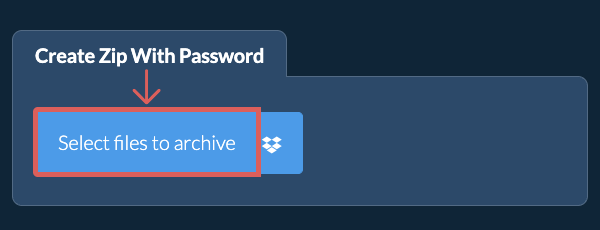
- Select files to archive First add the files you wish to include in the password locked Zip archive.
- Click Select files to archive to open the file chooser
- Drag and drop files directly onto ezyZip
Click Select files to archive to open the file chooser - (Optional) Set compression level(Optional) Set the desired compression level by clicking the down arrow next to "Zip Files".
- Click Zip FilesClick "Zip Files". It will bring up the password form.
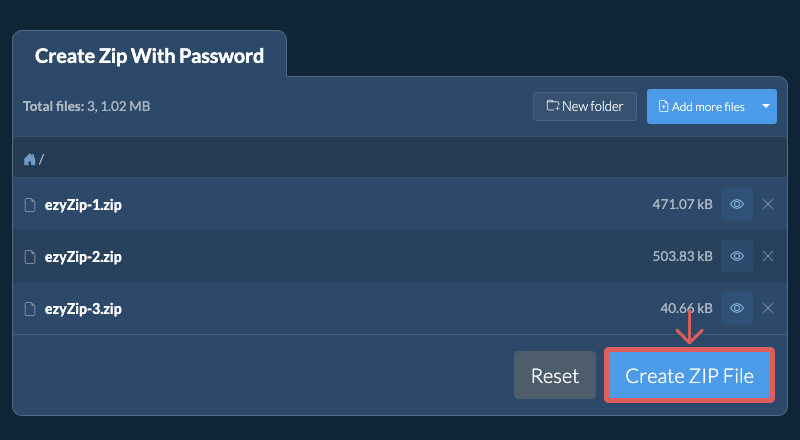
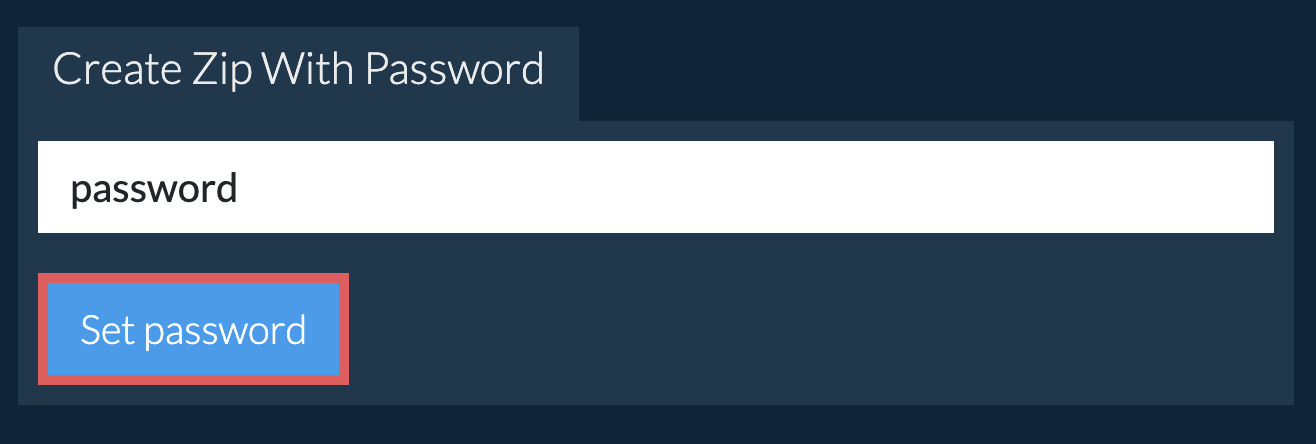
- Enter passwordInput your desired password for encrypting the ZIP file, then click on "Set Password". This will initiate the file compression process.
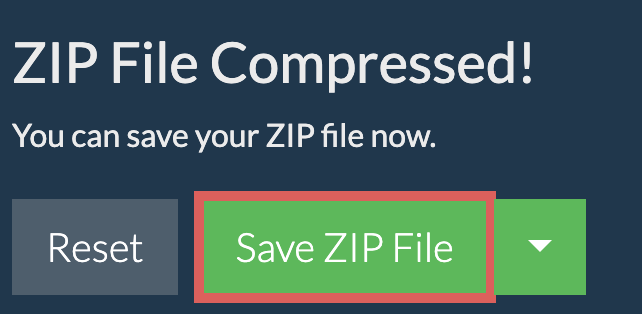
- Save your archiveOnce all the files are compressed, click "Save ZIP File" to save the archive to your selected destination folder.
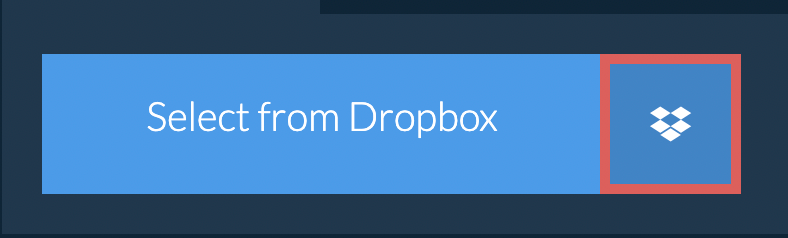
- Select from DropboxClick the down arrow (▾) next to the file selection button, then choose "Select from Dropbox".
- Pick your filesA small ezyZip window opens. Click "Continue to Dropbox", sign in to Dropbox if asked, then pick what you want to compress.
- Compress your filesezyZip downloads your selection into your browser. Then follow the instructions above.
- Save to DropboxWhen "Ready to Create ZIP File" appears, click the down arrow (▾) next to "Create ZIP" and choose "Dropbox". (In Firefox and Safari, use the down arrow next to "Save ZIP File".) The first time, Dropbox asks you to allow ezyZip access.
The file is saved in the /Apps/ezyZip folder.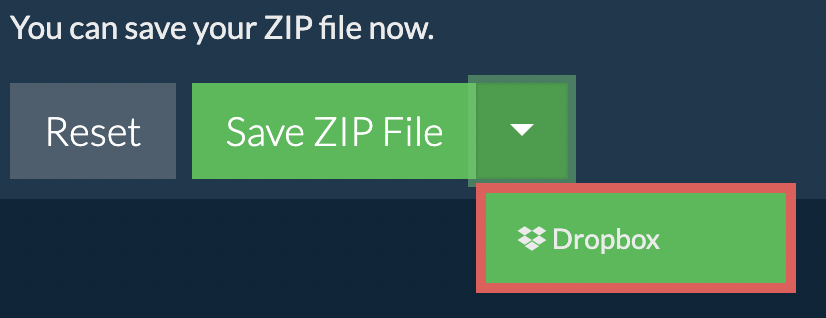
- Select from Google DriveClick the down arrow (▾) next to the file selection button, then choose "Select from Google Drive".
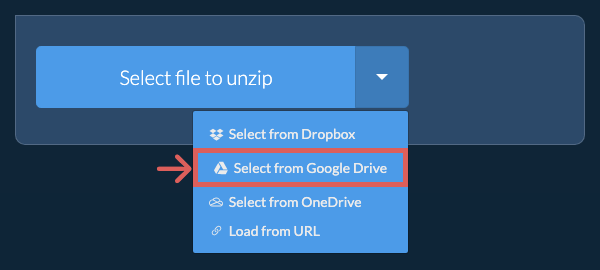
- Sign in and pick filesA Google Drive window opens. Sign in to Google if asked, allow ezyZip to access the files you choose, then pick what you want to compress.
- Compress your filesezyZip downloads your selection into your browser. Then follow the instructions above.
- Save to Google DriveWhen "Ready to Create ZIP File" appears, click the down arrow (▾) next to "Create ZIP" and choose "Google Drive". (In Firefox and Safari, use the down arrow next to "Save ZIP File".) Sign in to Google if asked.
The file is saved in the My Drive/ezyZip folder.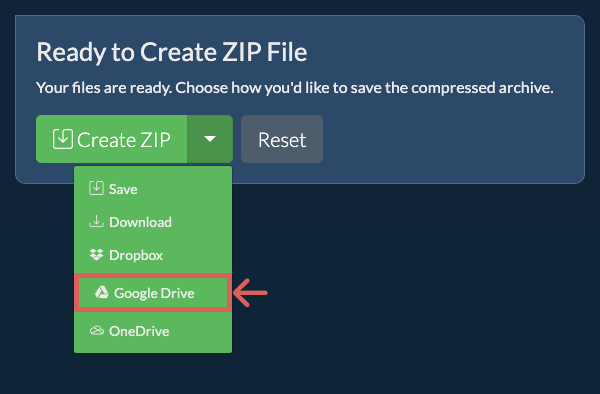
- Select from OneDriveClick the down arrow (▾) next to the file selection button, then choose "Select from OneDrive".
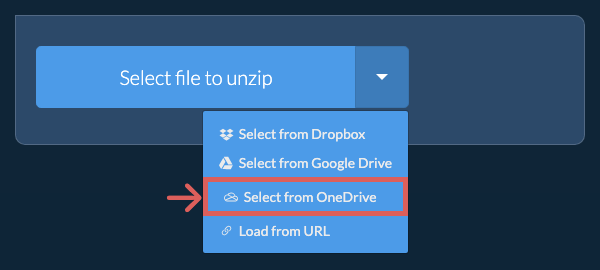
- Sign in and pick filesA OneDrive window opens. Sign in with your personal Microsoft account if asked and allow ezyZip access, then pick what you want to compress.
- Compress your filesezyZip downloads your selection into your browser. Then follow the instructions above.
- Save to OneDriveWhen "Ready to Create ZIP File" appears, click the down arrow (▾) next to "Create ZIP" and choose "OneDrive". (In Firefox and Safari, use the down arrow next to "Save ZIP File".) Sign in with your Microsoft account if asked.
The file is saved in the Apps/ezyZip folder.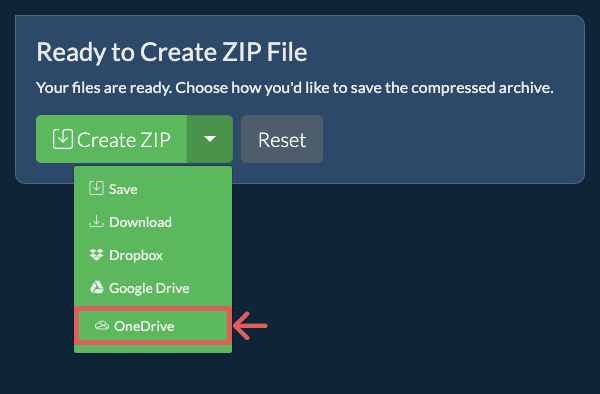
Frequently asked questions
We are continuously updating the system, so ensure you are using the latest version of one of the popular browsers or their variants. (e.g. Chrome, Firefox, Safari, Opera).
Please let us know via the feedback form if you have any issues.
Just think of it as a directory that may contain files and more sub-directories once it is opened by a zip utility program. It compresses the data using a lossless algorithm meaning there is no file quality degradation like in some compression formats (e.g. mp3, jpeg). The compression algorithm can vary however the most common is DEFLATE. The standard is constantly evolving with new algorithm and encryption options are added at regular intervals.
ezyZip offers various options to manipulate zip files including zipping individual files, create a zipped folder, extracting zip files or converting zip files.
Need help zipping files with native tools? Check out guides for Windows, MacOS and Linux.
ezyZip is a free zip and unzip online file compression tool that lets you zip files into an archive. It also supports unzip, allowing you to uncompress archived zip, zipx, rar, tar, tar.gz, 7z, and various other archive formats.
Unlike other zip and unzip online utilities, ezyZip does not require you to upload or download files to a server. There are no usage limits, allowing you to create large compressed files. It runs locally as a browser app, thus making it much quicker than other similar zip and unzip online tools. This also ensures your privacy will be protected as no file data will leave your browser.
ezyZip processes files directly in your browser. Unlike most online tools, your files are not uploaded to our servers, which means faster processing and better privacy. Take a look at the feature comparison below and we think you'll agree that ezyZip is the better choice for your file conversion needs.
| Feature | ezyZip | Other Online Tools |
|---|---|---|
| No Software Installation | Works Directly in Browser | Works Directly in Browser |
| Processing Location | Your Browser (No Upload) | Their Servers (Upload Required) |
| Privacy & Security | 100% Private (Files Never Leave Your Device) | Files Uploaded, Accessible by Others |
| Processing Speed | Fast (No Upload/Download Time) | Slow (Upload + Process + Download) |
| Registration Required | Never | Often Required for Large Files |
| Works Offline | Yes (After Page Load) | No |
| Cost | 100% Free | Free with Limitations / Paid Tiers |
| Established | Since 2009 (15+ Years) | Recent (May Disappear) |
Why client-side password-protected ZIP creation is more secure
When you create a password-protected ZIP archive with ezyZip, encryption runs entirely within your browser's WebAssembly sandbox. Here is why this is more secure than server-based encryption:
- Local Key GenerationEncryption keys are generated and consumed within WASM linear memory — your password is never transmitted over any network connection. The key derivation function runs entirely in the browser's isolated memory space, so your credentials cannot be intercepted in transit.
- Streaming Encrypted OutputThe encrypted archive streams directly to your disk through the File System Access API, with no intermediate server storage. Encrypted data is written in chunks, so at no point does the entire unencrypted archive exist in memory simultaneously.
- No Dual ExposureServer-based tools require sending both your files and your password to a remote server, creating two points of exposure that local processing eliminates. With ezyZip, neither your password nor your plaintext data ever leaves the browser sandbox.
- Exclusive ControlYour sensitive files and encryption credentials remain exclusively under your control throughout the entire process. There are no server logs recording your password, no temporary decrypted copies on remote disks, and no third-party access to your data at any stage.